Leave Your Message

China Top 10 Food Grade Film Manufacturers?

China’s Food Grade Film industry has become a major supplier for fresh produce, meat, dairy, bakery, and prepared foods. This guide examines ten leading Chinese manufacturers and the practical factors behind their market reputation.

The ranking considers production capacity, film types, quality controls, export experience, technical service, and application range. It also reviews films made from polyethylene, polypropylene, polyester, and specialized barrier structures. These materials may look similar on a factory sample table. Their performance can differ sharply under heat, moisture, cold storage, and high-speed packaging conditions.

Dr. Susan E. M. Selke, a respected packaging researcher, has stated, “Packaging is part of the food system, not an afterthought.” Her point is especially relevant here. A reliable Food Grade Film must protect food while supporting sealing, printing, transport, and shelf-life requirements. Compliance documentation matters too. Certificates alone are not enough.

Real buyers should request migration test reports, material specifications, production samples, and traceability records. A transparent manufacturer should explain resin sources, thickness tolerance, sealing temperature, and storage conditions. Small details matter. A weak seal can waste an entire shipment.

This list is useful, but it is not absolute. Rankings can change as factories expand, certifications expire, or customer service declines. Some companies present impressive catalogs yet offer limited technical support. That is worth questioning. The strongest supplier is not always the largest one; it is the one that consistently matches film performance with the buyer’s equipment and food application.
China Top 10 Food Grade Film Manufacturers?

What Makes a Film Manufacturer Food Grade?

What Makes a Film Manufacturer Food Grade?

A food-grade film manufacturer controls every material that may contact food. This includes resin, additives, inks, coatings, and adhesives. Each component needs documented compliance with applicable food-contact rules. In the United States, suppliers commonly reference FDA 21 CFR requirements. In Europe, Regulation (EC) No 1935/2004 requires materials to avoid harmful migration.

Testing must match real use. A reliable producer checks overall migration, specific migration, odor, taste, seal strength, and heat resistance. Testing should reflect temperature, contact time, food type, and storage conditions. A frozen-food pouch needs different evidence from a film used with hot soup. Small details matter.

Traceability is equally important. The manufacturer should identify production lots, raw-material sources, test methods, and corrective actions. BRCGS Packaging Materials guidance emphasizes documented hygiene, risk assessment, and supplier control. The OECD’s Global Plastics Outlook reported that only about 9% of plastic waste was recycled globally, highlighting the need for careful material selection and realistic recovery claims.

Compliance is not the same as quality.

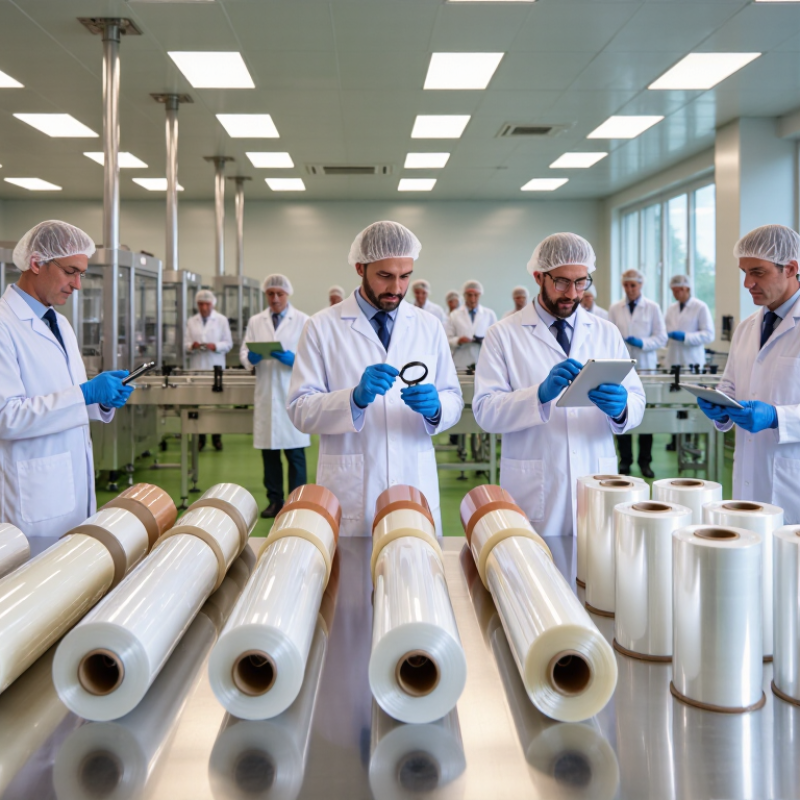
A certificate alone proves little if production records are incomplete. In practice, clean-room discipline, calibrated equipment, trained operators, and retained samples reveal more. Some manufacturers still treat food-grade status as a document exercise. That is a weakness worth questioning. A capable supplier welcomes audits, shares test evidence, and explains limitations before problems reach the packing line.
China Top 10 Food Grade Film Manufacturers? – What Makes a Film Manufacturer Food Grade?

Food-grade film manufacturing is determined by documented food-contact compliance rather than company size alone. The chart shows selected specific migration limits (SMLs) under EU Regulation No. 10/2011 for substances that may be relevant to plastic food-contact materials. Lower limits indicate stricter migration control requirements.

A qualified manufacturer should also demonstrate positive-list compliance, overall and specific migration testing, good manufacturing practices, batch traceability, controlled raw materials, and documented testing for the intended food type, contact time, and temperature. Reference: EU Regulation No. 10/2011.

How China’s Top 10 Food Grade Film Manufacturers Are Selected

China Top 10 Food Grade Film Manufacturers?

Selecting China’s top 10 food grade film manufacturers requires more than checking production volume. A credible review begins with food-contact compliance, traceability, and stable manufacturing processes. We examine test reports for migration, odor, thickness, seal strength, and heat resistance. Independent laboratory results provide stronger evidence than sales claims. Factory audits also review clean production areas, raw material control, and employee training. Practical experience matters.

A reliable manufacturer should explain its resin sources, quality checkpoints, and complaint handling process. We compare pilot samples with regular production batches, because one excellent sample proves little. Delivery records, technical support, and customization ability also influence the selection. However, rankings remain imperfect. Certificates may expire, and factory conditions can change after an audit. Every conclusion needs periodic review.

Tips: Request recent food-contact documents and batch records. Test films under real packaging conditions, including heat, moisture, and storage time. Ask for a clear replacement policy. Inspect packaging hygiene before signing a long-term agreement. Do not rely on price alone. A low quote may hide weaker consistency.

Profiles of China’s Leading Food Grade Film Manufacturers

China’s leading food grade film manufacturers serve different packaging needs rather than offering identical products. Some specialize in BOPP and CPP films for snacks, bakery goods, and dry foods. Others focus on polyethylene films for fresh produce, frozen products, and inner liners. Their facilities often include clean production areas, automated extrusion lines, and online thickness monitoring. Details matter.

Several manufacturers have developed high-barrier structures using coatings, adhesives, or multilayer extrusion. These films can help protect food from oxygen, moisture, light, and odor transfer. Retort film producers require strong heat resistance and stable sealing performance. Recyclable mono-material specialists are also gaining attention, although real performance depends on the complete package design. Not every line fits every application.

A reliable manufacturer should provide food-contact declarations, batch traceability, migration test results, and clear technical data. Independent audits can reveal more than a polished brochure. Experienced buyers usually examine seal strength, coefficient of friction, puncture resistance, and print adhesion under actual filling conditions. Some suppliers offer trial rolls before mass production, which reduces avoidable risk. Still, laboratory results may not fully reflect warehouse humidity or high-speed packing. That gap deserves honest review. Manufacturers with export experience often understand documentation and compliance requirements for different markets, including applicable Chinese, European, and United States food-contact rules. Their authority should come from verifiable records, not broad promises.

Materials, Technologies, and Product Applications

China’s top food-grade film manufacturers are increasingly judged by materials, process control, and application results. Smithers’ The Future of Global Flexible Packaging to 2028 valued global flexible packaging at about US$268.9 billion in 2023. Food remains its largest end-use sector. Chinese producers commonly supply PE, PP, PET, PA, EVOH, and metallized films. Multilayer structures improve oxygen and moisture protection. However, they can complicate recycling.

Technology decides performance. Co-extrusion enables thinner films with controlled sealing layers. High-barrier coatings help protect coffee, sauces, meat, and frozen foods. Retort films must tolerate heat, pressure, and repeated handling without delamination. Vacuum packaging needs stable puncture resistance. A practical test includes seal strength, oxygen transmission, haze, and migration results. Small defects matter.

Applications are becoming more specific. Mono-material PE or PP structures support simpler recycling streams, but they may lose barrier performance. Grand View Research estimated the global food packaging market at approximately US$363.3 billion in 2023, with growth driven by convenience and packaged food demand. Manufacturers therefore need both scale and traceability. Compliance with food-contact requirements, including China’s GB 4806 series, should be verified through documented testing. Some supplier claims remain too broad. Buyers should request batch records, third-party reports, and real product trials before selection.

China Top 10 Food Grade Film Manufacturers? - Materials, Technologies, and Product Applications

Note: The table presents anonymized, representative capability profiles commonly found among leading Chinese food-grade film manufacturers. Specifications are typical commercial ranges and may vary by product, structure, and certification.
Rank Manufacturer Profile Primary Material Typical Film Structure Typical Thickness Core Technology Main Food Applications Common Compliance Focus Key Performance Characteristics
1 Profile A Biaxially Oriented Polypropylene (BOPP) BOPP / printing ink / adhesive / CPP or PE 18–40 μm Tenter-frame biaxial orientation, corona treatment, and high-speed lamination Snack foods, biscuits, confectionery, dry foods, and noodle packaging Food-contact declarations, migration testing, GMP controls, and applicable Chinese GB standards High clarity, good printability, moisture resistance, and strong machine-running performance
2 Profile B Cast Polypropylene (CPP) BOPP / CPP or metallized BOPP / CPP 20–80 μm Multi-layer cast extrusion with sealant-layer formulation Retortable and standard snack packs, frozen foods, and dry food pouches Food-contact resin traceability, heat-seal testing, and overall migration limits Low seal-initiation temperature, balanced stiffness, good transparency, and reliable sealing
3 Profile C Linear Low-Density Polyethylene (LLDPE) PE / PE or PET / PE laminated film 30–120 μm Blown-film or cast-film extrusion with multi-layer coextrusion Meat, seafood, frozen foods, produce, and general food liners Food-grade resin documentation, odor control, migration testing, and hygiene management Excellent toughness, puncture resistance, moisture barrier, and heat-sealing performance
4 Profile D Polyethylene Terephthalate (PET) PET / PE, PET / CPP, or PET / AL / PE 8–25 μm for film layers Biaxial orientation, corona treatment, metallization, and adhesive lamination Coffee, sauces, retort food, powdered products, and high-graphics packaging Food-contact coatings and adhesives, migration control, and heat-resistance validation High tensile strength, dimensional stability, heat resistance, and strong print surface
5 Profile E Polyamide (PA / Nylon) PA / PE, PA / EVOH / PE, or PA / CPP 12–50 μm for PA layers Biaxial orientation or coextrusion with tie-layer technology Vacuum meat packaging, cheese, seafood, retort pouches, and high-puncture packs Food-contact nylon qualification, moisture conditioning, and sterilization testing High puncture and abrasion resistance, toughness, and good gas barrier when dry
6 Profile F Ethylene Vinyl Alcohol (EVOH) PE / tie / EVOH / tie / PE or PA / EVOH / PE 40–150 μm total film Multi-layer coextrusion with moisture-protective outer layers Fresh meat, processed meat, cheese, coffee, sauces, and oxygen-sensitive foods Oxygen-transmission testing, food-contact compliance, and layer-integrity verification Very high oxygen barrier, aroma retention, and extended shelf-life potential
7 Profile G Polyvinylidene Chloride (PVDC)-Coated Film BOPP / PVDC or PET / PVDC 12–40 μm Precision coating, drying, curing, and roll-to-roll inspection Spices, processed foods, dry products, and oxygen- or moisture-sensitive goods Coating residuals, migration compliance, odor testing, and barrier performance verification High oxygen and moisture barrier with good aroma retention
8 Profile H Metallized Polypropylene or PET Metallized BOPP / PE or metallized PET / PE 10–30 μm metallized layer Vacuum aluminum deposition, optical-density control, and lamination Coffee, chips, powdered milk, pet food, snacks, and light-sensitive foods Metal adhesion, pinhole inspection, optical density, and food-contact adhesive compliance Light barrier, improved oxygen and moisture protection, and reflective appearance
9 Profile I Paper-Plastic Composite Film Paper / PE, paper / PET / PE, or paper / bio-based coating 60–180 μm total laminate Water-based or solvent-free lamination, flexographic printing, and coating Tea, bakery items, dry snacks, takeaway food, and specialty food bags Paper food-contact compliance, ink and adhesive migration, and recyclability claims Natural appearance, stiffness, good printability, and customizable grease resistance
10 Profile J Compostable or Bio-Based Film PLA, PBAT / PLA, or cellulose-based coated film 20–100 μm Cast extrusion, biodegradable compound formulation, and compostability-focused coating Fresh produce, bakery products, dry foods, sachets, and short-life packaging Food-contact safety, industrial compostability certification, disintegration, and labeling requirements Renewable or compostable positioning, adjustable stiffness, and moderate barrier performance

Quality Standards, Certifications, and Buyer Considerations

China’s top food grade film manufacturers should be assessed through verified quality systems, not attractive samples alone. A reliable supplier should provide current ISO 9001 records and food safety certification, such as ISO 22000, FSSC 22000, or BRCGS. Certification scope matters. It must cover the actual film plant and production process.

Food-contact compliance also requires careful checking. Ask for declarations matching the target market, such as EU food-contact rules, FDA requirements, or applicable Chinese GB standards. Independent migration tests should identify the tested material, thickness, temperature, and food type. A report without these details is weak evidence. Request batch-level certificates of analysis, resin traceability, and records for ink, adhesive, and additives.

Performance testing should match the package’s real use. Check seal strength, puncture resistance, oxygen transmission, moisture transmission, and thickness tolerance. For frozen food, a film may crack during repeated bending. For oily products, migration behavior deserves closer attention. Audit production hygiene, storage conditions, and corrective-action records when possible. Samples can pass while regular batches vary. That happens.

A buyer should also review minimum order quantities, lead times, export packaging, and complaint handling. Ask how nonconforming rolls are isolated. Request a pilot order before signing a long contract. The cheapest quotation may hide unstable thickness or delayed testing. I would still question every document’s issue date and laboratory status. Credibility needs evidence.